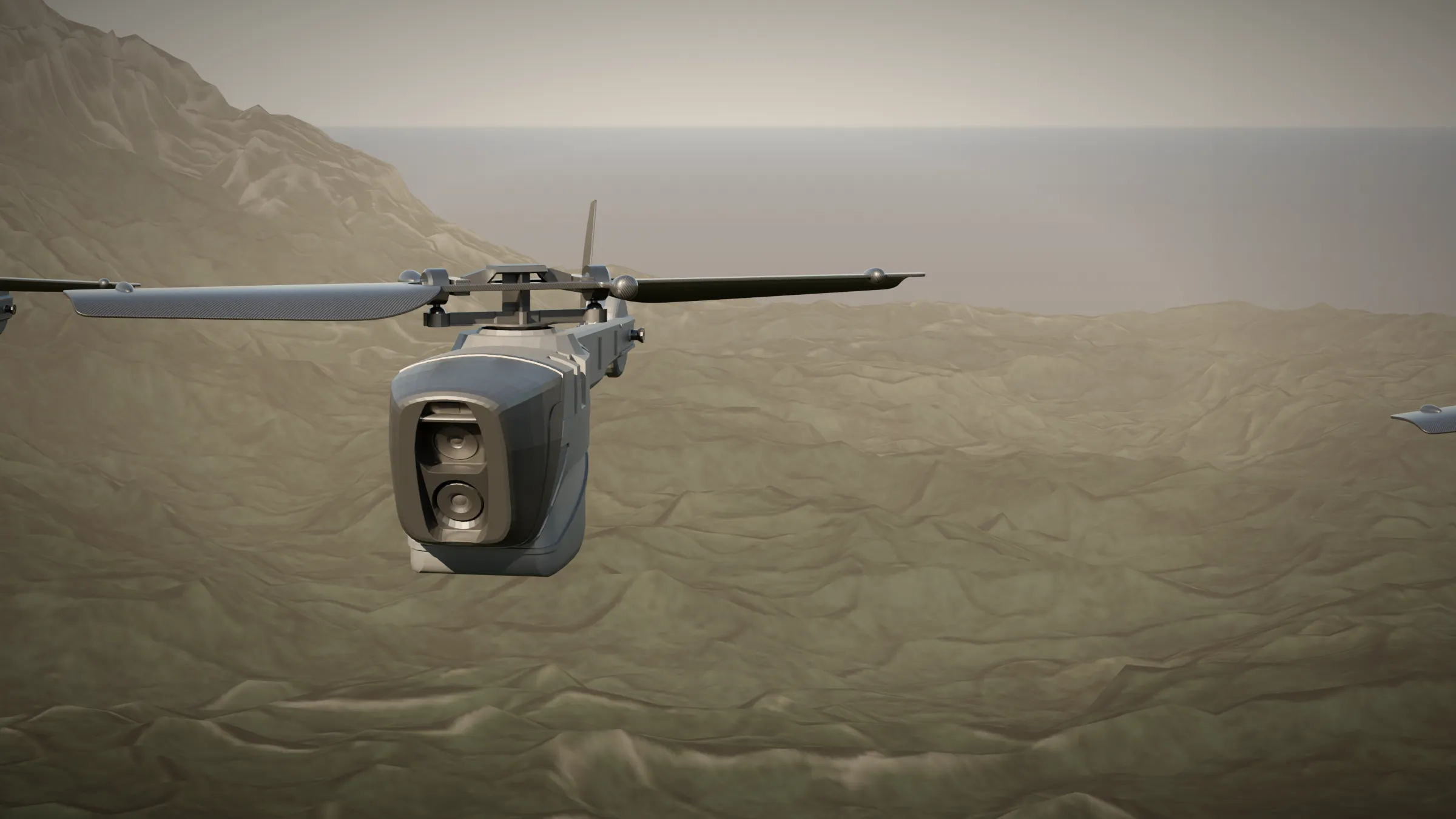
R7 · Autonomous reconnaissance aircraft
The ground, from above.
Endurance
9 h
Acoustic
38 dB
Link
14 km
Case to air
3 min
(01) Overview
A helicopter you carry like a rifle case.
R7 is a single-rotor helicopter, two metres nose to tail and 4.6 kg ready to fly. It hovers, stares and creeps along a ridgeline at walking pace, things a fixed-wing drone can’t do and a quadcopter can’t do for nine hours.
It launches from a hand, flies its own route, holds a stable stare on anything the operator selects, and lands itself on its skid. One person sets it up. Nobody has to fly it.
(02) Airframe
Every part earns its place.
Carbon-composite boom, a shrouded tail rotor and a sealed sensor nose. Five parts that matter most in the field.

01
Sealed sensor nose
EO/IR gimbal behind a heated, hydrophobic window.
02
1.86 m main rotor
Low-tip-speed blades for a quiet, slow beat.
03
Composite tail boom
Swaps by hand in under two minutes.
04
Shrouded tail rotor
Cuts noise and keeps fingers safe at launch.
05
Hot-swap battery bay
Swap packs without powering down the avionics.
(03) Sensor
Two eyes. One picture.
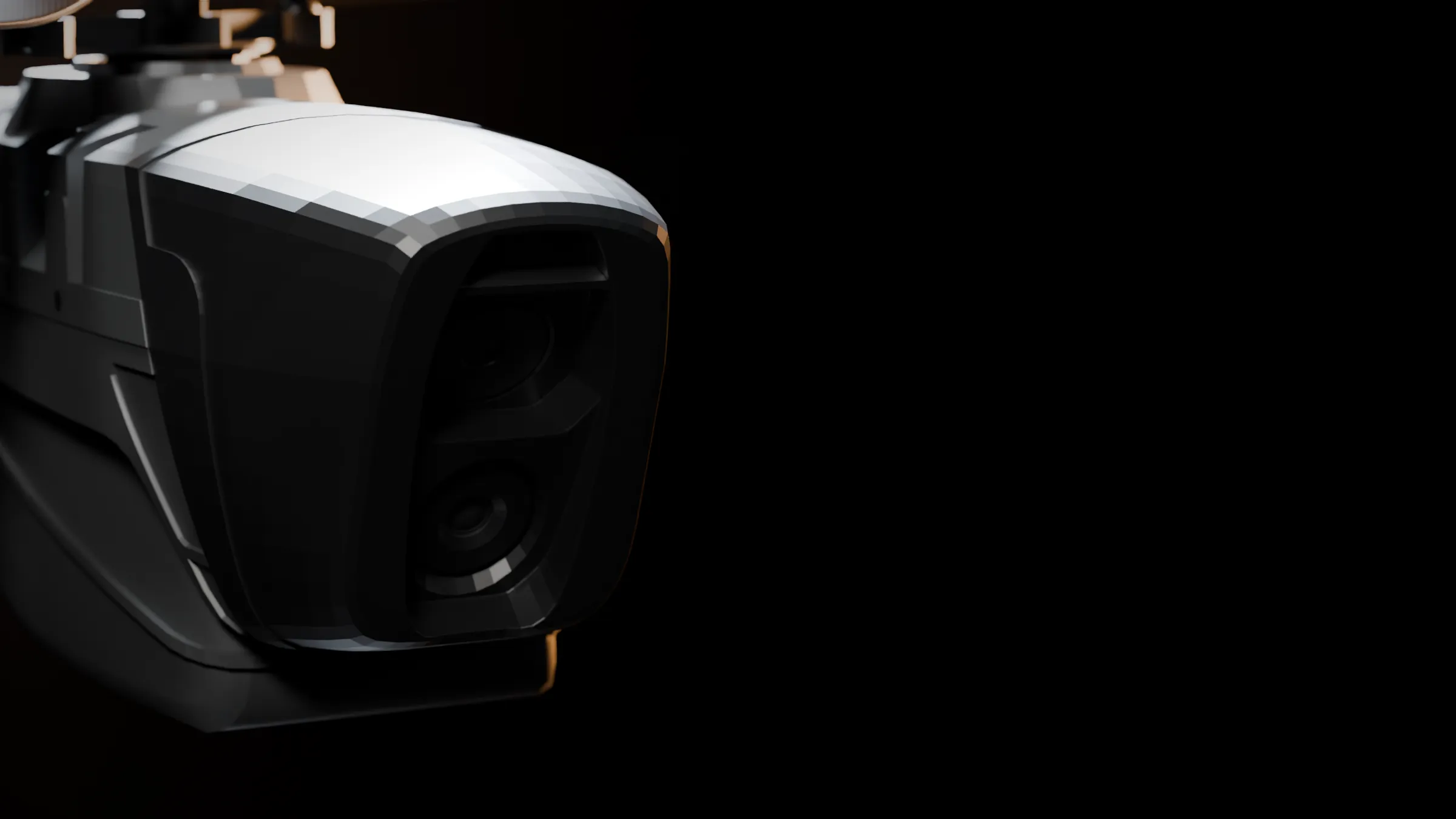
A stacked daylight and thermal pair on a three-axis gimbal, fused on board, so R7 keeps seeing through haze, smoke and the last hour of dusk.
Daylight
4K · 30× optical zoom
Thermal
640 × 512 px · 8–14 µm
Stabilisation
3-axis · < 0.01°
Recognition
Vehicle at 3 km · person at 1.2 km
On-board fusion
EO + IR, < 40 ms

(04) In the field
Quiet enough to hold a stare over a valley for an afternoon without anyone below looking up.
(05) Configurations
One airframe. Three jobs.
Every R7 shares the same airframe, battery and case. The nose module and software licence decide what it’s for.
R7 Relay
Carries the link over the ridge.
Lightweight daylight camera
Dual-band mesh radio, 2 W
11 h endurance
Pairs with any R7 Recon
R7 Recon
Most fielded
Find it, follow it, share it.
EO/IR gimbal with 30× zoom
Sightline track proposals
9 h endurance
Three-aircraft formations
R7 Trainer
Learn on the real thing.
Recon airframe, unlocked simulator
Instructor override link
Curriculum for 2-day certification
Spares kit doubled
(06) In the case
Everything, in one 72 cm case.
14 kg packed. Carries on a back, fits in a car boot, opens to flight-ready in three minutes.
01
R7 airframe, rotor folded
4.6 kg
02
Batteries, hot-swappable
× 3
03
Rugged ground tablet with Sightline
10.1″
04
Directional mesh antenna
14 km
05
Field charger, vehicle + mains
90 min
06
Spares: blades, boom, skid
Tool-free
(07) Specifications
The numbers.
Measured at sea level, 15 °C, R7 Recon configuration. Full test reports are shared under NDA during a briefing.
Airframe
Length
2.00 m
Main rotor diameter
1.86 m
Mass, ready to fly
4.6 kg
Materials
Carbon composite, Al 7075
Ingress protection
IP54
Performance
Endurance
9 h
Cruise / dash
54 / 90 km/h
Service ceiling
4,200 m AMSL
Wind tolerance
15 m/s sustained
Acoustic signature
38 dB(A) at 120 m
Navigation & autonomy
GNSS
Multi-constellation, anti-jam
GNSS-denied
Visual-terrain matching
Autonomy
Waypoint, orbit, follow, return
Formation
Up to 3 aircraft
Fail-safes
Lost link, low battery, geofence
Link & environment
Datalink
Encrypted mesh, AES-256
Range
14 km LOS, relayed beyond
Video latency
< 180 ms
Operating temperature
−20 to +50 °C
Launch / recovery
Hand launch · skid landing
Demonstrations in Zürich, Turin or at your range
See R7 fly your terrain.
Get Template
$200